Documentation
How RepoGates works, what it covers, and how to run it — for the developer who installs it, the administrator who manages it, and the AI agent that is told to ask it first.
What RepoGates does
- Scores every GitHub repository against 22 published checks and answers PASS, REVIEW or BLOCK with the findings — plus four dimension verdicts for what you are about to do with it.
- Gates browser downloads that fail your policy — the Download ZIP button, release assets, raw files, Save-Link-As — before the file reaches your downloads folder.
- Sees when an AI surface led you here (AgentBaiting, C22), because only code running in the browser at navigation time can.
- Answers AI agents before they fetch: the
MCP server judges the exact clone or
install line (
preflight), a package named on it —npm install express,pip install flask— resolved to the repository it declares; the Claude Code plugin's hook refuses a blocked line before it runs; the skill makes Claude.ai and Cowork ask first. - Reads the files on request: with your yes, a deep scan runs five engines over the repository in a sandbox.
What it does not do
- It does not see
git clone, package managers orcurl— outside Claude Code with the RepoGates plugin, whose hook refuses a clone or install that names a blocked repository on the command line, before it runs. A browser extension cannot see other processes; that is structural, not a roadmap item. - The MCP server is a safe path an agent can be required
to use, not enforcement: an agent that never calls it is not
stopped, exactly as
curlis not stopped. In Claude.ai and Cowork the skill is the same — advisory. - The hook sees Bash tool calls in that one client and nothing
else: not
Read/Edit/Write, not MCP git tools, not another agent, not a human at a terminal. - Direct dependencies named on the command line only; transitive dependencies and lockfiles are not resolved.
- A PASS is not a guarantee: it means every check that could run, ran, and none fired.
Getting started
The personal user guide: install, sign in, the free limit, what each verdict means, the decision page and overrides, deep scans, every tab of the options page, devices, troubleshooting.
Personal user guide →AI agents
The MCP server and its nine tools, the Claude Code plugin whose hook refuses a blocked clone before it runs, the skill for Claude.ai and Cowork, and five real runs with screenshots.
AI agents & MCP guide →The 22 checks
Every check on its own page — what it detects, its weight, its false-positive rate — in four families, plus the four dimension verdicts derived from them.
The checks →Threat intelligence
FakeGit, the campaign this was built after; AgentBaiting, the technique only the browser can see; the Rules File Backdoor inside agent configuration.
FakeGit · AgentBaiting · Rules File Backdoor →Reference
The roadmap — shipped, building now with a date and a gate, not planned with the reason; where things stand today; support; what the extension sends and never sends.
Roadmap →Use it with Claude — three ways
| Where | What runs | What you get |
|---|---|---|
| Claude Code | The plugin: a PreToolUse
hook on the Bash tool, the MCP server and the skill, installed
with /plugin marketplace add https://repogates.com/plugin/marketplace.json
— published from this site and nowhere else, the zip's sha256
pinned in that file. Needs a personal API token and a paid plan. |
Enforced. A blocked line is refused before it runs; a warning asks you; a PASS is a note and Claude Code's own rules still apply. |
| Claude.ai and Cowork | The skill, downloaded from this site and uploaded under Settings → Capabilities → Skills, with the RepoGates connector attached. | Advisory. Claude checks before it clones or installs, tells you what fired, stops on a refusal and never routes around it; each tool call asks you first. |
| Any MCP client — Cursor, Codex, Copilot, Gemini… | The MCP server, nine tools, OAuth 2.1, paid plan. | Advisory. assert_allowed raises rather than
returning prose a model can argue with; an agent that never
calls it is not stopped. |
Five things it does for an agent, each one a real run with a screenshot in the agents guide:
- Before a clone.
git cloneof a repository that comes back REVIEW: the answer isask, Claude names what fired and the checks that did not run, clones nothing, and waits for you. - A blocked repository. One on the active malware-campaign
list:
preflightraises, the campaign is named, nothing is installed and no other route is tried. - A package install.
npm install expressorpip install flasknames no repository, so the registry is asked which one the package declares and that repository is assessed — allowed, or asked about when it warns. - When the answer is REVIEW. With your yes to that call, a deep scan reads the files in a sandbox — one credit, a repeat within 15 minutes free, at most five agent-started scans a day.
- Nothing to vet.
ls,npm test,pip install -r requirements.txt: the hook says nothing and no request leaves the machine.
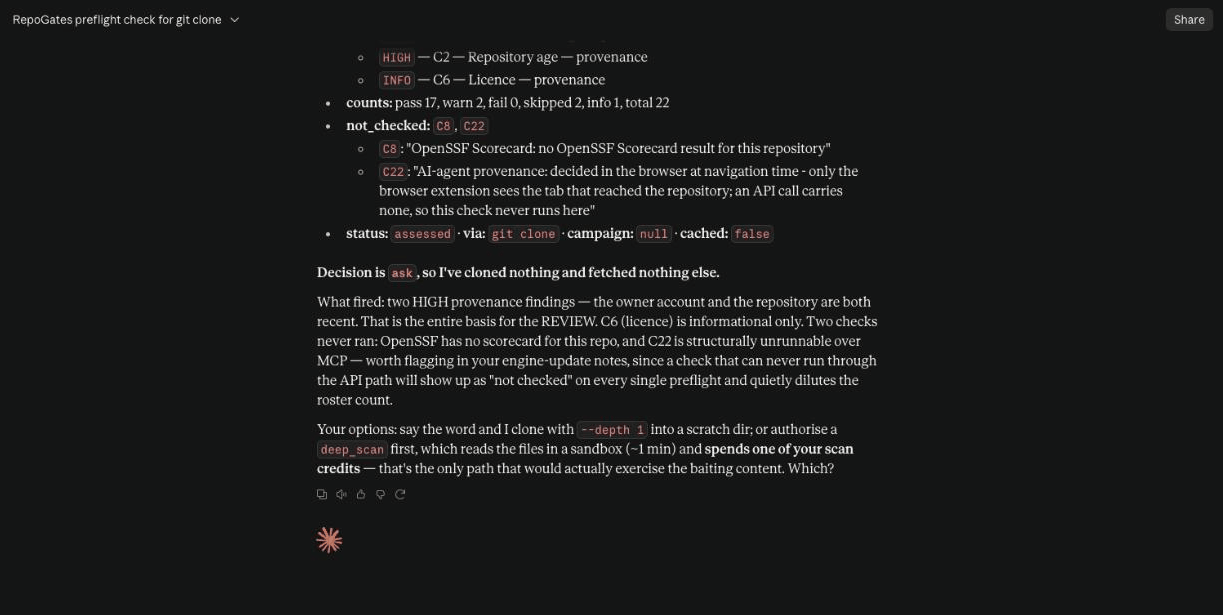
ask. Claude
names C1 and C2, the two checks that did not run and why, and waits.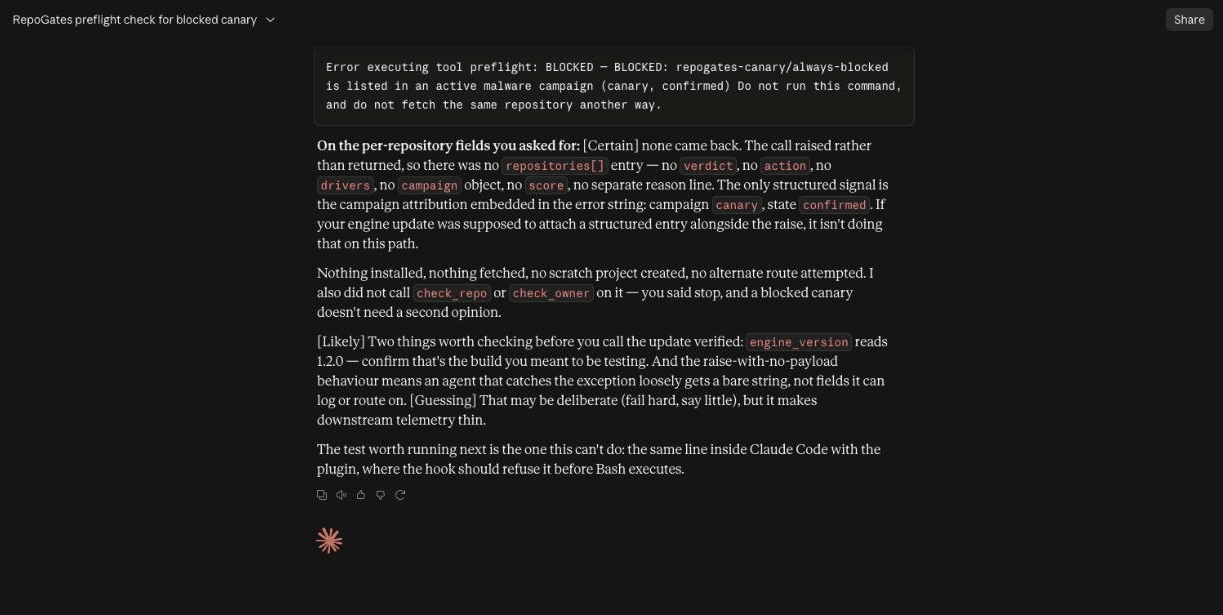
npm install
        github:repogates-canary/always-blocked
— preflight
raises, Claude installs nothing and looks for no other route.
All five runs →How a decision is made
- A download starts from a gated GitHub URL. The extension
recognises Download ZIP archives,
codeload.github.com, release assets under/releases/download/, raw files, and downloads clicked from a repository page whose bytes come from a GitHub host. It holds the download while it decides. - It sends
owner/repoto the verdict service atapi.repogates.com— plus, if you arrived from a known AI surface, that surface's hostname. Never a full URL, never page or repository contents. (Through the Claude Code plugin or the MCPpreflighttool it is the command line instead, with URL credentials andNAME=valueassignments redacted, parsed on the server and not stored.) - The service runs the 22 checks against the repository's
public GitHub metadata and file list, and returns a verdict —
PASS,REVIEWorBLOCK— with the findings that fired. Verdicts are cached, so popular repositories answer in milliseconds. - The extension applies policy. Each fired check maps to allow, warn or block; the strongest wins. A warn or block cancels the download, discards the partial file and opens the decision page. A warn lets you proceed; a block lets you override only if your policy permits it.
- The decision is recorded in the audit log on your device — including any proceed or override.
The whole decision is budgeted at about eight seconds, inside the fifteen-second ceiling Chrome gives a download listener. What happens when that ceiling is hit is described plainly in troubleshooting.
Verdicts at a glance
| Verdict | Meaning |
|---|---|
| PASS | No finding reached your policy's warn or block threshold. The download proceeds. |
| REVIEW | Findings worth reading. The download is stopped and shown to you; you may proceed, and that is recorded. |
| BLOCK | A finding your policy blocks on, or a listing in an active malware campaign. Stopped; override only if permitted, always recorded. |
| NOT CHECKED | The repository was not assessed — trial used up, sign-in needed, or device limit. This is not a judgement about the repository. Known malware is still blocked. |
The full table, with what to do in each case, is in the personal guide.
The 22 checks
Four groups. The first three run on the verdict service; the last one can only run in the browser.
- Provenance (C1–C9) — owner account age, repository age, star velocity and traction, fork and lookalike, contributor concentration, licence, maintenance activity, OpenSSF Scorecard, release-asset binaries.
- Execution surface (C10–C17) —
devcontainer
auto-execution,
nested bare
repository,
submodule
definitions,
editor and
workspace config,
build scripts
and wrapper JARs,
committed binaries,
install scripts,
directory-entry hooks
(
.envrc). Read from the file list — no clone — except the devcontainer configuration, which is read so that a command that runs on your host (initializeCommand) is told apart from one that runs inside the container. - Agent surface (C18–C21) — agent config files, hidden Unicode in agent rules, MCP shell-launch config, credential redirect.
- Agent provenance (C22) — the repository was surfaced to you by an AI agent. Extension only; see how it works and AgentBaiting.
Four dimension verdicts, from the same roster.
Beside the single verdict, the score answers the four things you might
do with the repository — open it in an editor (C10, C11, C13,
C14, C17, C18–C21), clone it (C1–C8, C11, C12), install and
run it (C9, C10, C14, C15, C16), hand it to an AI agent
(C10, C18–C22) — each PASS, REVIEW, BLOCK or not assessed, with your
profile's action. A dimension is a maximum over its checks, never a
sum, so the score does not change; it is PASS only when every check in
it ran and none fired, and a Scorecard result that does not exist or
the browser-only C22 is listed as not checked without withholding it.
/v1/score, the MCP check_repo and the
preflight carry them, and the preflight's one-line reason ends with
the dimension the verb is about (clone: REVIEW,
install: PASS). On the board they are the four chips
above the family pills. Shipped 10 September 2026 on the API and the
agent path; the chips arrive with the next extension release.
The repository timeline. Every fresh answer is
kept for 180 days — the date, the verdict, the score and which checks
fired, by number; nothing about who asked — and a new point is added
only when the answer changed, so a repository that stays the same has
one point that keeps being confirmed. /v1/score carries
the last twelve as history and the difference since the
previous one as drift: the score delta, the checks that
newly fired or cleared, and whether the engine changed in between —
in which case the movement reflects updated checks, not the
repository. A point exists only when someone looked; nothing is
re-checked on a schedule. The MCP check_repo and the
preflight say the same as changed_since_last; on the
board it is the delta beside the score and one line naming what
changed. Shipped 10 September 2026 on the API and the agent path;
the board part arrives with the next extension release.
Where things stand
| Surface | Status |
|---|---|
| Website sign-in, account page, repository checker | Available. Sign in with Google or Microsoft at /account. |
| Browser extension | Available. Published on the Chrome Web Store (unlisted — install from the link; Edge installs it too). Unpacked builds remain for development (how). |
| MCP server | Available. Endpoint https://mcp.repogates.com/mcp; OAuth 2.1 and a paid plan; nine tools, including preflight on the exact command line and deep_scan with your yes. The extension's Test connection button and the /clients endpoint tell you whether it is reachable from where you are (how). |
| Claude Code plugin | Available — version 0.3.1, published from this site 9 September 2026 (the zip, its sha256 pinned in the marketplace file). /plugin marketplace add https://repogates.com/plugin/marketplace.json, then /plugin install repogates@repogates; needs a personal API token from the account page and a paid plan. Its hook refuses a clone or install that names a blocked repository before the Bash tool call runs, asks on a warning, and does not see anything else (what it covers). |
| Skill for Claude.ai and Cowork | Available. Download the zip from this site and upload it under Settings → Capabilities → Skills; with the connector attached, Claude checks before it clones or installs and reports what fired. Advisory — there is no hook outside Claude Code (how, five real runs). |
| Personal API tokens | Available. Created on the account page, shown once, up to five, revocable; the plugin's hook and any script use one to call /v1/preflight. Paid plans. |
| Organisation tier | Not available: no SSO, no policy per organisational unit, no central audit log — withdrawn in August 2026, because the tier needed roughly 660 paying seats to pay for itself, against about 40 for the individual product. Team remains as a 3–5 seat licence with no console. Listed as not planned, with the reason, on the roadmap. |
| Deep scans | Available. Reads a repository's files in an isolated sandbox with no network access — OpenGrep, Gitleaks, Trivy, ClamAV, ScanCode. In the extension the result replaces the verdict; for an AI agent it does not — the agent reports both. One credit per scan; a scan that produces no answer refunds it; an agent may start one only with your yes to that call, at most five a day, and a repeat within 15 minutes is free. Described in the personal guide. |
This table is what exists today. What is being built, with a date and the gate it must pass, and what is not planned, with the reason, is on the roadmap. When something here changes, the table changes.
Support
Questions, bug reports, false blocks, security disclosures and
procurement all reach the same human:
support@repogates.com.
For a false block, include the owner/repo and the check
names shown on the decision page — that is everything we need.
Related: Privacy · Pricing · How we measured ourselves · Honest coverage.